The form of descant sung today, a soprano countermelody above a congregational hymn tune, emerged and grew rapidly following the introduction of the 1906 English Hymnal, which some consider the music editor's (Ralph Vaughan Williams) magnum opus (he  THAXTED arr. for strings, flute, oboe, horn, trumpet, & timp.might not agree). The volume's majestic arrangements include obscure and forgotten tunes curated by Vaughan Williams, along with familiar tunes improved by his harmonizations, and a few original tunes. These arrangements invited such treatment, as merely adding a desultory, plagal 'amen'
 Ordination hymm
(with revised text)seemed insufficient homage to this new standard of composition.
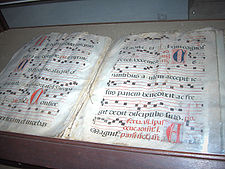
As you might expect, however, the practice and use of the descant had an earlier form, as the term itself implies: descant - 'against the song,' from dis-, a Latin cognate implying opposition, and cantus, 'song;' a word that lives today as the words such as chant and cantata. In its early practice, it was often extemporized, and frequently sung in a different style or rhythm, the high voice at triple tempo, hence the alternate name of the soprano voice, treble.
New arrangements for Easter hymns
Two favorites arranged for five part strings (String Quintet or Ensemble) joining versions for Brass Quintet and Timpani, Two Trumpets, or (EASTER HYMN only) String Quartet with Two Trumpets.
EASTER HYMN - "Jesus Christ is risen today"
ELLACOMBE - "The day of resurrection"
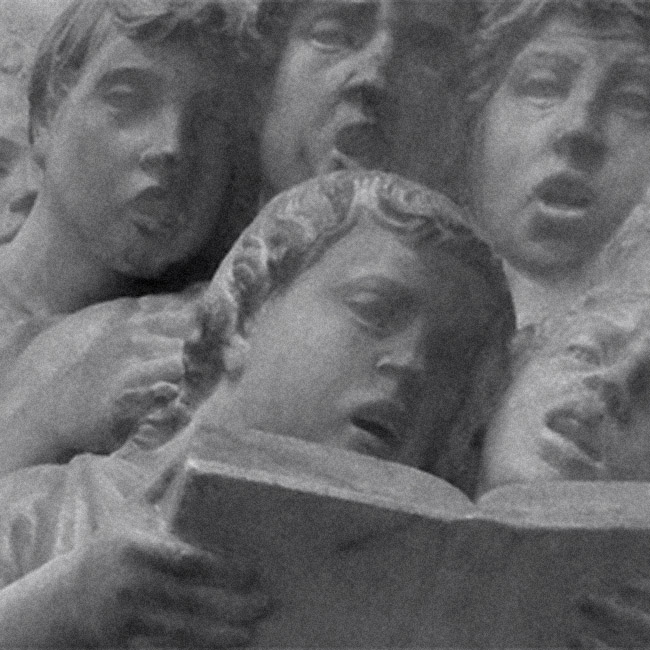
Image: boy singers from Cantoria, a series of reliefs featuring young singers and musicians, Lucca della Robbia, Florence, 14thC.
the music of Gideon Cox
Set me as a Seal
Wedding anthem for SSA or TTB
Alleluia
This composition provides a harmonic framework that invites creativity and improvisation: creative license is freely issued.
Sweet was the Song
The hymn Sweet was the song the Virgin sung appeared c.1600 and is found in William Ballet's Lute Book in the Library of Trinity College, Dublin.
If ye Love Me
This text, found in John 14:15, is one of the most memorable sayings of Christ - and hardly needs a theologian to explain it. It only needs us to follow.
Duo Seraphim
Duo seraphim clamabant, alter ad alterum: Sanctus, Sanctus, Sanctus, Dominus Deus Sabaoth
(Two seraphs called one to the other: Holy! Holy! Holy! Lord God of Hosts
For double choir
Locus iste
Locus iste a Deo factus est, inaestimabile sacramentum, irreprehensibilis est.
(This place was made by God, a priceless sacrament; it is without reproach. ~ The Gradual from the Mass for the Dedication of a Church.)
O vos omnes
O vos omnesis a responsory, originally sung as part of the Latin liturgies of Holy Week, and now frequently sung as a motet. The traditional liturgical use is for Holy Saturday.
Preces and responses
A fresh setting of the traditional sung prayers for evensong. (Formatted on 11x17 for duplex printing, resulting in a four-page score)
Four anglican chants
Four anglican chants for psalms and canticles. For more information, or to commission more of these works, use the contact form.
Anglicant Chants II
Three additional anglican chants for psalms and canticles. For more information, or to commission more of these works, use the contact form.